Guide for Parents and Carers
Useful information on MyMindWorks and mood disorders
Welcome
Your teenager has been referred for a review of their mental health difficulties. This brief guide provides an introduction to mood disorders and a digital resource called MyMindWorks(MMW) they now have access to.
Using MMW will not impact their place in the waiting list for therapy. It is an optional additional resource within the current National Institute of Health Research funded Wait Less Study that they may find helpful.
What is a mood disorder?
Mood disorders (such as depression and anxiety) are more common in teenage rather than the childhood years. They involve emotional symptoms such as sadness, irritability, emptiness, worry and fearfulness. They are also associated with change in behaviours such as social withdrawal from family and friends, tiredness and loss of energy.
Trying to talk to a young person when they are experiencing these feelings can be hard for parents. A teenager may not say what is on their mind, they might be easily annoyed and generally act in unpredictable ways different to their usual behaviour.
Are mood disorders common?
Yes. Over a 12-month period about 1 in 10 adolescents experience 4 or more of these symptoms and difficulties in an episode of a mood disorder. Studies generally agree that around 40-50% of all mood disorders begin during the teenage years. Repeated anxiety and depression are highly associated with a lower quality of life as an adult, as they impair educational performance, relationship development and increase the risk of unemployment.
Mood disorders that are dominated by feelings of sadness, emptiness and irritability are less common than those dominated by worries or fearfulness about themselves and what others think of them. Anxiety and depression occur together in almost every mood disorder.
What can we do about mood disorders?
The simplest approach is to seek support and advice, whether that is from parents, teachers, or other trusted adults on how the teenager can better look after themselves when feeling intensely distressed. Whilst many episodes resolve in a few weeks a proportion will benefit from more professional support and treatment.
Clinically effective treatments are available but more young people are being referred to specialist mental health services than ever before. Unfortunately, this means the wait times for assessment and treatment can be many weeks or even months. Currently there is no clear-cut method available to support teenagers and their parents whilst waiting to see a mental health specialist in an NHS clinic.
Using Digital Mental Health Methods
We have produced a digital on line mental health support program that we hope will be a part of the answer to getting more support to young people whilst they wait for practitioner assessment and perhaps treatment. Whilst there are many hundreds of mental health and wellness digital applications, very few are designed with and for mentally unwell adolescents.
MyMindWorks (MMW) is the digital version of Brief Psychosocial Intervention (BPI), a face-to-face talking treatment that is as effective as CBT (Cognitive Behavioural Therapy) and is approved by NICE UK (the NHS National Institute for Health and Care Excellence) for use with depressed teenagers in the NHS. BPI has been definitively shown to reduce symptoms of depression and anxiety in adolescents, with less than 7% returning to use mental health services in the 12 months following treatment. MMW has been developed with the consultation of young people and is currently undergoing clinical trial.
What does MyMindWorks involve?
The content of MyMindWorks (MMW) contains many of the same features as in-person BPI therapy, presented in five modules onscreen. Clicking a module reveals 3-5 ‘episodes’ of content for the young person to watch or read at their own pace. If watched all in one go, the whole program would take roughly 50 minutes, but we suggest that young people work at their own pace and to view it over multiple sessions.
The structure of MMW content is shown below:
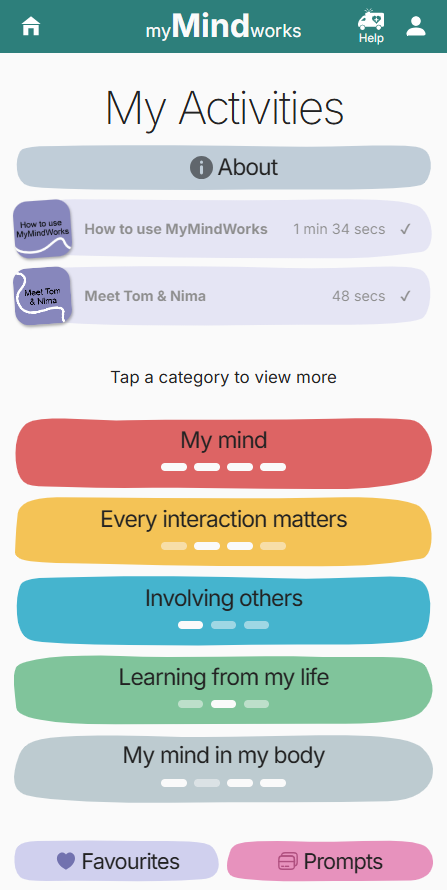
The MMW program design makes it easy to go back and forth. There is a section for noting ‘favourites’ to return to. Two trained NHS BPI practitioners talk on video in various sections of the program about mood disorder and encourage the adolescent to complete MyMindWorks in their own time and their own way.
You as a parent can have your own login so you can see the content for yourselves, separately from your child’s login.
Clinical Trial
The current version of MyMindWorks has been tested by well and mentally unwell adolescents, and completed by parents and practitioners. Their advice on content and how the program looks has been incorporated for example flexibility use and having videos with real clinicians rather than actors.
Teenagers in the Wait Less study will have eight weeks in which to use MyMindWorks. It is accessed via a mobile phone or another device of their choosing.
This trial is the first of its kind. We have chosen to test MyMindWorks with young people on waiting lists. This will determine if, by using this program, their overall mental health and wellbeing can be improved while waiting for assessment and treatment.
Please note that using MyMindWorks is not a replacement for seeing a mental health practitioner. Using it does not change or remove their place on the waiting list.
From the pilot studies with 13 young people, no side or adverse effects have emerged when using the program.